Why Construction Loans Are Rare in Cameroon?
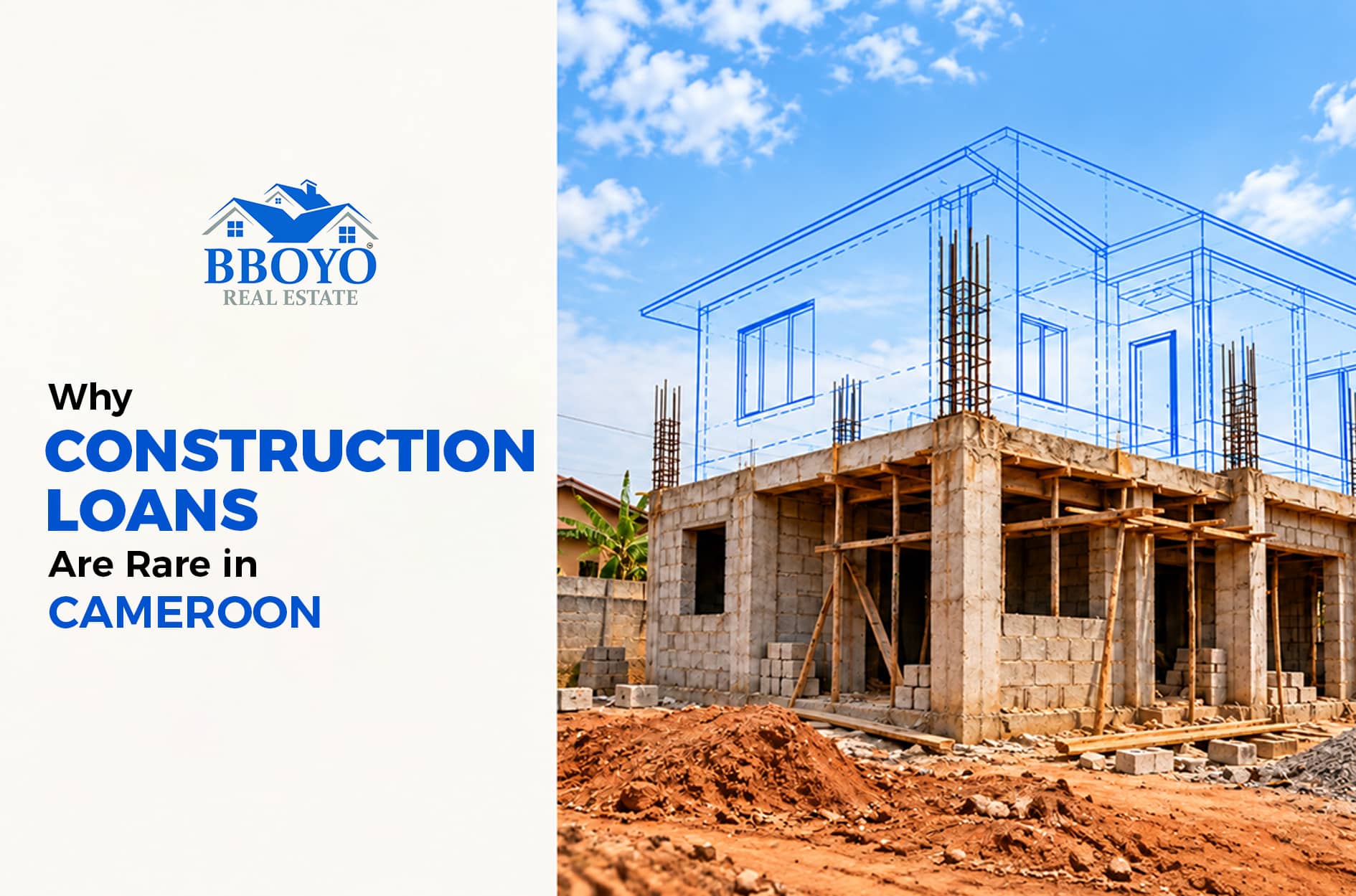
A family in Douala inherits a plot in Logbessou. The Titre Foncier is clean, the land is worth roughly 15 million XAF, and the plan is simple: build a four-bedroom house over eighteen months. They walk into a bank expecting something like a mortgage, only spread over the build. What they get instead is a much shorter facility, a demand for a personal contribution up front, and a repayment schedule that assumes the house is basically already standing.
That gap between what buyers expect and what real estate lenders in Cameroon actually offer is one of the least understood parts of the local property market. Most people know land is expensive and paperwork is slow. Fewer people understand why the loan to build on that land is often harder to get than the loan to buy a finished one.
This piece walks through what construction finance in Cameroon actually looks like right now, who lends it, why banks price it the way they do, and what alternatives exist for buyers who can't get a bank to say yes. It also gets into the wider real estate financing challenges in Cameroon that sit behind those decisions, so you know what you're up against before you apply.
Construction Loans in Cameroon Are a Small, Shrinking Slice of the Market
Formal financing for housing in Cameroon covers only a fraction of what the country needs. Officials at Crédit Foncier du Cameroun, the state's main housing bank, have pointed out that funds available for real estate financing in the country cover barely 10% of actual demand, against an officially estimated housing deficit running into the millions of units. Most of what gets financed goes toward buying or refinancing existing property, not building new.
The result is that self-construction accounts for roughly 97% of housing in Cameroon, financed out of pocket, in savings tontines, or through informal borrowing rather than a bank. That's not a cultural preference. It's what happens when the formal system rarely says yes to a construction loan in the first place, and it's one of the housing finance problems in Cameroon that rarely gets discussed outside banking circles.
Why Construction Loans Are Limited: They're a Different Risk Than a Standard Property Loan
A standard property loan is secured against something that already exists. A construction loan is secured against something that doesn't exist yet, disbursed in stages, against a project that could stall halfway. For a bank, that's a structurally different bet, and it changes almost everything about how the loan is priced and monitored.
A few of the practical differences:
-
Disbursement: ordinary loans are disbursed once, while construction loans are disbursed in tranches according to construction milestones, indicating that the bank has to check that construction itself takes place rather than merely validating paper documents.
-
Collateral at the outset: a property loan is based on an asset that already exists, while a construction loan is based on a piece of land and a promise.
-
Risk of abandonment: a stalled build with no income potential is a much weaker asset to recover than a habitable house.
-
Term: property loans can stretch over decades; construction loans in Cameroon are typically capped much shorter, often tied to the build timeline itself.
This is also where the real risk to banks concentrates, and it's the core of the risks of construction loans in general, not just in Cameroon. If a borrower runs out of money at the foundation stage, or a contractor disappears with part of the funds, the bank is left holding a half-built structure on land it has to seize and resell, in a market where enforcing that isn't quick or guaranteed. That single risk profile is a big part of why construction finance in Cameroon stays scarce even as demand for housing keeps climbing.
The Collateral and Documentation Wall Most Applicants Hit
Ask most banks in Cameroon what construction financing hinges on, and the answer starts with the same document: a clean Titre Foncier. Without one, the conversation usually ends before it starts. Land without a formal title, or land still moving through the registration process, generally can't be used as collateral at all.
Even with a title in hand, lenders typically expect a full documentation package before considering a construction loan, including:
-
A valid building permit issued by the local council
-
Architectural and technical plans, sometimes with a geotechnical study
-
A detailed, itemized cost estimate for the build
-
Proof of a personal financial contribution to the project, so the borrower has skin in the game
-
A clean credit history with no defaults on record
For a first-time local buyer without a permanent employment contract, or a diaspora buyer trying to assemble this package remotely, that list alone can rule out a bank loan long before interest rates even enter the conversation. It's also worth knowing that most property development loans in Cameroon aimed at larger residential or mini-estate projects ask for an even thicker file, since the lender is underwriting a developer's whole pipeline, not just one family's house. Cameroon's dual land tenure system and the ongoing difficulty of securing titled land in many regions only add to this, which is part of why land verification matters as much as the financing itself.
Interest Rates That Turn Repayment Into a Gamble
Where construction loans are available, the pricing reflects the risk banks are taking on. Crédit Foncier du Cameroun's own published rates give a useful benchmark: its ordinary land and construction loan runs around 6% TTC per year, its rental loan and developer loan around 7% TTC, while a subsidized social loan for smaller projects can run as low as 3.75% to 5% TTC. Commercial banks stepping into real estate lending have priced some products close to 7.5%, compared with roughly 10% for a standard consumer loan, positioning real estate credit as cheaper than ordinary borrowing, but still a meaningful cost layered on top of construction material prices that rise with every delay.
The deeper problem is term length. Mortgage and property loan products in Cameroon are typically structured for repayment periods of five to ten years, which is short for financing meant to cover a full real estate investment cycle. Comparing mortgage vs construction loans in Cameroon side by side makes the gap clear: a mortgage repays against a finished, income-generating or livable asset from month one, while a construction loan repays against a project that isn't earning or sheltering anyone until it's done. A borrower repaying a construction loan on a five-to-ten-year clock, on top of a project that may itself run over budget or over schedule, is carrying two kinds of risk at once: construction risk and repayment risk, with very little room for either to go wrong.
Commercial Banks, Crédit Foncier, and the Private Lenders Filling the Gap
Cameroon's banking sector is concentrated. Afriland First Bank and Société Générale together hold close to 38% of the country's outstanding loans and deposits, and bank lending policies in Cameroon at that scale tend to favor safer, shorter, better-collateralized products over open-ended construction financing.
Crédit Foncier du Cameroun remains the most construction-friendly formal lender specifically because it was built for this purpose. Since 1977, it has extended roughly XAF 261 billion in loans, which financed the construction of about 69,500 houses and the development of more than 15,700 building plots. But its classic land and construction loan is only open to employees on a permanent contract for at least two years, which excludes informal workers, the self-employed, and much of the diaspora unless they can show equivalent formal income.
Where banks and Crédit Foncier both fall short, three types of lenders tend to step in:
-
Microfinance institutions, offering smaller, faster loans, often with less collateral required but noticeably higher rates.
-
Developer-backed payment plans, where a construction or real estate company finances the build in phases directly, common for mini-estates and gated developments.
-
Private and cooperative financing, informal but often faster than a bank, though with far less regulatory protection if something goes wrong.
Each of these fills a real gap, but each also shifts risk back onto the buyer in ways a regulated bank loan wouldn't.
Building Without a Bank: What This Means for You
The honest pattern, seen across enough construction projects to be predictable rather than surprising, is this: builds financed entirely through informal savings and phased self-funding tend to move slower but rarely collapse outright, because there's no lender to default to. Builds that lean on a mix of a small formal loan and a personal contribution tend to stall exactly when the loan tranche runs out before the next construction milestone is reached, leaving a half-finished structure until more cash is found. The common thread in failed projects isn't the lender. It's a mismatch between how fast money arrives and how fast the build actually needs it.
Cameroon's banking sector is also still expanding, with new licenses issued in recent years and a stated goal of reaching 30 banks by 2030. More competition in lending doesn't fix titling delays or collateral rules overnight, but it does put pressure on existing lenders to design products that fit how Cameroonians actually build, in phases, with mixed formal and informal funding, rather than in one lump sum.
None of this means construction is unfinanceable in Cameroon, only that it takes more preparation than buying a finished home does. The real estate funding issues in Cameroon that make construction loans rare, thin collateral rules, short terms, and a banking sector still finding its footing, are structural, not personal, and they're the same for every buyer working through them.
If you're planning a build, the practical takeaway is to treat financing and land verification as one project, not two. A clean, properly registered title is what makes a construction loan possible at all, and confirming that title before you commit any money is exactly what protects you whether or not a bank ever enters the picture.
Talk to a local Bboyo agent before you commit to a plot, and consider starting the Two-Week Due Diligence process on any land you're planning to build on. Verifying the title and the paperwork early gives you a real shot at qualifying for formal financing later, and protects your money either way.